
History
Wally Carroll began work on his first concertina in the Summer of 2002. This first instrument took a year and a half to complete and was based on a careful study of a 1914 wood ended Wheatstone Linota. Nearly every part (with the exception of the tiny screws that bolt the reed tongues down) was made in Wally's basement workshop. Over the next several months the instrument was played a great deal and received many upgrades.
Following the completion of instrument #001, Wally's father, Walt, joined him in the operation and the production screamed ahead at the alarming pace of 2 instruments per year! From there it eventually made it to as many as 6 instruments per year before the operation outgrew the basement shop and was moved to a more appropriate location. Additional help was taken on at this time and production has been on the rise ever since. Currently, we are able to produce about 24 custom made instruments per year.
Wally Carroll began work on his first concertina in the Summer of 2002. This first instrument took a year and a half to complete and was based on a careful study of a 1914 wood ended Wheatstone Linota. Nearly every part (with the exception of the tiny screws that bolt the reed tongues down) was made in Wally's basement workshop. Over the next several months the instrument was played a great deal and received many upgrades.
Following the completion of instrument #001, Wally's father, Walt, joined him in the operation and the production screamed ahead at the alarming pace of 2 instruments per year! From there it eventually made it to as many as 6 instruments per year before the operation outgrew the basement shop and was moved to a more appropriate location. Additional help was taken on at this time and production has been on the rise ever since. Currently, we are able to produce about 24 custom made instruments per year.
Philosophy
From the beginning, the focus has always been to make the very best sounding and best playing instruments. Only the highest quality materials and an obsessive attention to details go into our work. Every instrument is made to order. As part of the process, a considerable amount of time and resources is spent in researching and developing new materials, manufacturing processes and design ideas.
From the beginning, the focus has always been to make the very best sounding and best playing instruments. Only the highest quality materials and an obsessive attention to details go into our work. Every instrument is made to order. As part of the process, a considerable amount of time and resources is spent in researching and developing new materials, manufacturing processes and design ideas.
Team
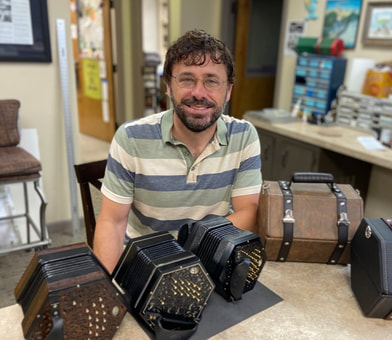
Wally Carroll - Design, CNC Machine Programming and Operation, Woodworking, Metalworking, Leatherworking, Finishing, Final Instrument Tuning and Setup, Customer Contact, Paperwork, Toilet Repair.
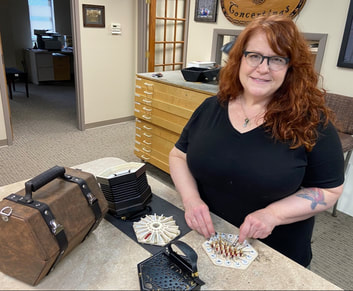
Jeni Balcom - Instrument Assembly, Reed Assembly and Tuning, Spray Finishing and Polishing, Lever Installation, Leather Sewing, Pad and Valve Installation, Design.
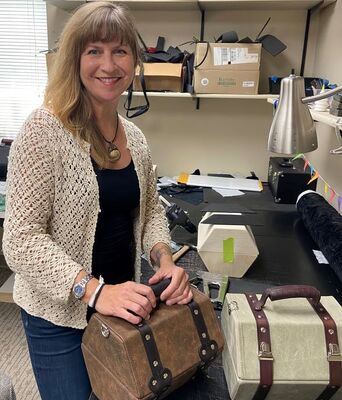
Amy Bogard - Case Making, Leatherworking, Metalworking, Button Polishing and Assembly. PHOTO COMING SOON!
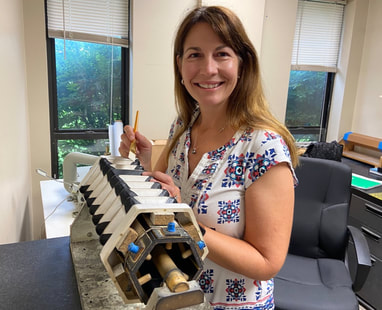
Jackie Carroll - Bellows Making and Party Planning.
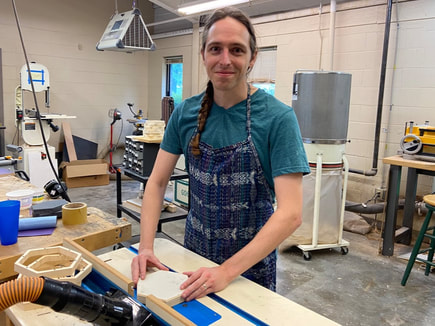
Justin Bridges - Woodworking, Metalworking, CNC Machine Programming and Operation.
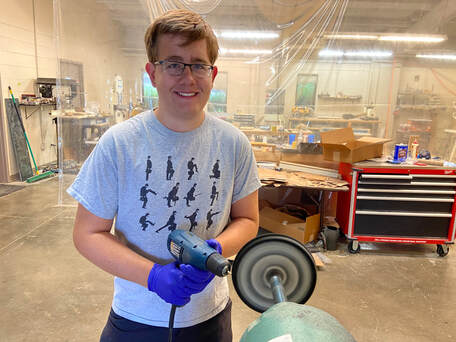
James Carroll - Woodworking, Button Polishing and Assembly.
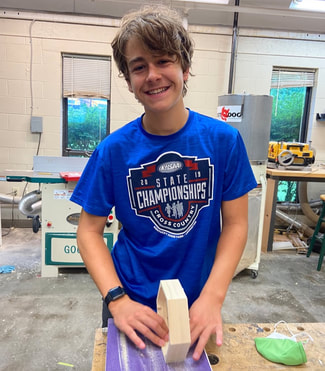
Alex Carroll - Woodworking, Website Redesign (coming soon)
Reeds
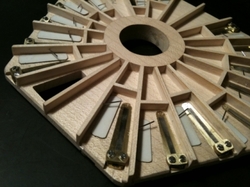
The reeds in a concertina are often thought of as the soul of the instrument. Although many factors contribute to the particular tone and play-ability of an instrument, the reeds certainly play an enormous role in both regards. From a manufacturing standpoint, because of the incredibly tight tolerances and the various angles that need to be machined into the reed shoes, they also present the biggest challenge to the concertina maker. In our instruments, we only use what are known as "Traditional Concertina Reeds" which we manufacture ourselves. As in the vintage instruments, our reed shoes are made from brass and the tongues are made from blue tempered spring steel. The tongues are carefully profiled using sophisticated computer controlled grinding and cutting machines followed up by intensive hand filing. Our reeds are closely modeled on the reeds from a 1914 Wheatstone Linota.
The reeds in a concertina are often thought of as the soul of the instrument. Although many factors contribute to the particular tone and play-ability of an instrument, the reeds certainly play an enormous role in both regards. From a manufacturing standpoint, because of the incredibly tight tolerances and the various angles that need to be machined into the reed shoes, they also present the biggest challenge to the concertina maker. In our instruments, we only use what are known as "Traditional Concertina Reeds" which we manufacture ourselves. As in the vintage instruments, our reed shoes are made from brass and the tongues are made from blue tempered spring steel. The tongues are carefully profiled using sophisticated computer controlled grinding and cutting machines followed up by intensive hand filing. Our reeds are closely modeled on the reeds from a 1914 Wheatstone Linota.
Action
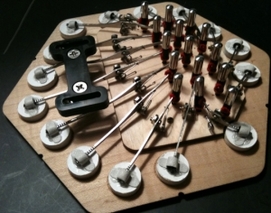
The action in a concertina consists of the buttons, lever assemblies, pads and springs.
Buttons: The buttons are a combination of two parts: a plastic stem and a metal cap (brass or nickel silver). Using a plastic stem greatly reduces the weight of the instrument and is consistent with the practice of the earlier makers who often used either wood or plastic stems under metal caps.
Lever assemblies: The lever arms are cut from stainless steel sheets and are attached to the lever post with an adjustable screw. Vintage makers, Wheatstone and Jeffries, used crushed rivets to attach the lever arms to the posts. This system provides a more stable and therefore quieter and faster mechanism than some of the alternatives but it still has a problem in that over time, as the parts wear, a noticeable clicking sound develops (similar to a typewriter). It is sometimes possible to recrush the rivets a little to eliminate the clicking but it is very difficult to not go too far thereby causing the lever to permanently seize. After making several dozen instruments using riveted actions, we developed our own adjustable action which allows the owner to tighten the action the required amount in order to eliminate any clicking that may develop. We designed our own threaded rivet for this purpose and have it manufactured to an extremely close tolerance. It has the advantage in that if it is overtightened, the procedure can easily be reversed giving the owner endless attempts to get it right without causing any permanent damage.
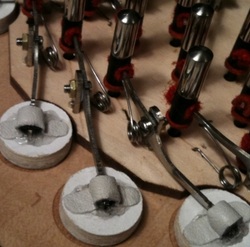
Pads and Springs: We manufacture our pads using a sandwich of cardboard, felt and leather and we make our springs out of stainless steel wire.
Bellows
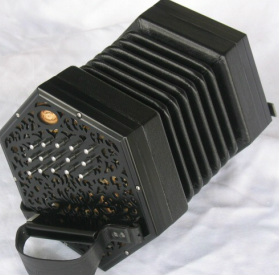
Our bellows is made up of over 300 pieces of leather, linen, and cardstock. The leather that covers the outside of the bellows is a high quality bookbinder's goatskin with an embossed 'cross hatch' texture similar to that found on vintage Wheatstone and Lachenal bellows. The bellows are available in solid black or with decorative papers.
Our bellows is made up of over 300 pieces of leather, linen, and cardstock. The leather that covers the outside of the bellows is a high quality bookbinder's goatskin with an embossed 'cross hatch' texture similar to that found on vintage Wheatstone and Lachenal bellows. The bellows are available in solid black or with decorative papers.
Woodworking
The most important wooden parts of the concertina, with respect to tone production, are the reedpans and the action boards. True to tradition, our reedpans and action boards are made from imported English Sycamore. Far less important, with respect to tone, are the ornate woods used on the ends of the instrument. Most of our ends are made in the traditional manner by laminating together multiple sheets of veneer to create a stable, rigid endplate. The advantage of using a laminated end over a solid wood end is that the instrument is far less prone to developing cracks (which is practically inevitable in a solid wood construction as can be seen in surviving lesser quality vintage instruments such as Lachenals and Jones). We never put solid ebony ends on our instruments as this wood is particularly prone to cracking and was actually rarely (if ever) used on vintage instruments. For our solid black instruments, we use a hard black laminate material which is extremely stable and has qualities very similar to solid ebony without the risk of developing cracks. The frames are made from a dimensionally stable, lightweight resin and the endplate frames are covered in ornate wood veneers.
The most important wooden parts of the concertina, with respect to tone production, are the reedpans and the action boards. True to tradition, our reedpans and action boards are made from imported English Sycamore. Far less important, with respect to tone, are the ornate woods used on the ends of the instrument. Most of our ends are made in the traditional manner by laminating together multiple sheets of veneer to create a stable, rigid endplate. The advantage of using a laminated end over a solid wood end is that the instrument is far less prone to developing cracks (which is practically inevitable in a solid wood construction as can be seen in surviving lesser quality vintage instruments such as Lachenals and Jones). We never put solid ebony ends on our instruments as this wood is particularly prone to cracking and was actually rarely (if ever) used on vintage instruments. For our solid black instruments, we use a hard black laminate material which is extremely stable and has qualities very similar to solid ebony without the risk of developing cracks. The frames are made from a dimensionally stable, lightweight resin and the endplate frames are covered in ornate wood veneers.